

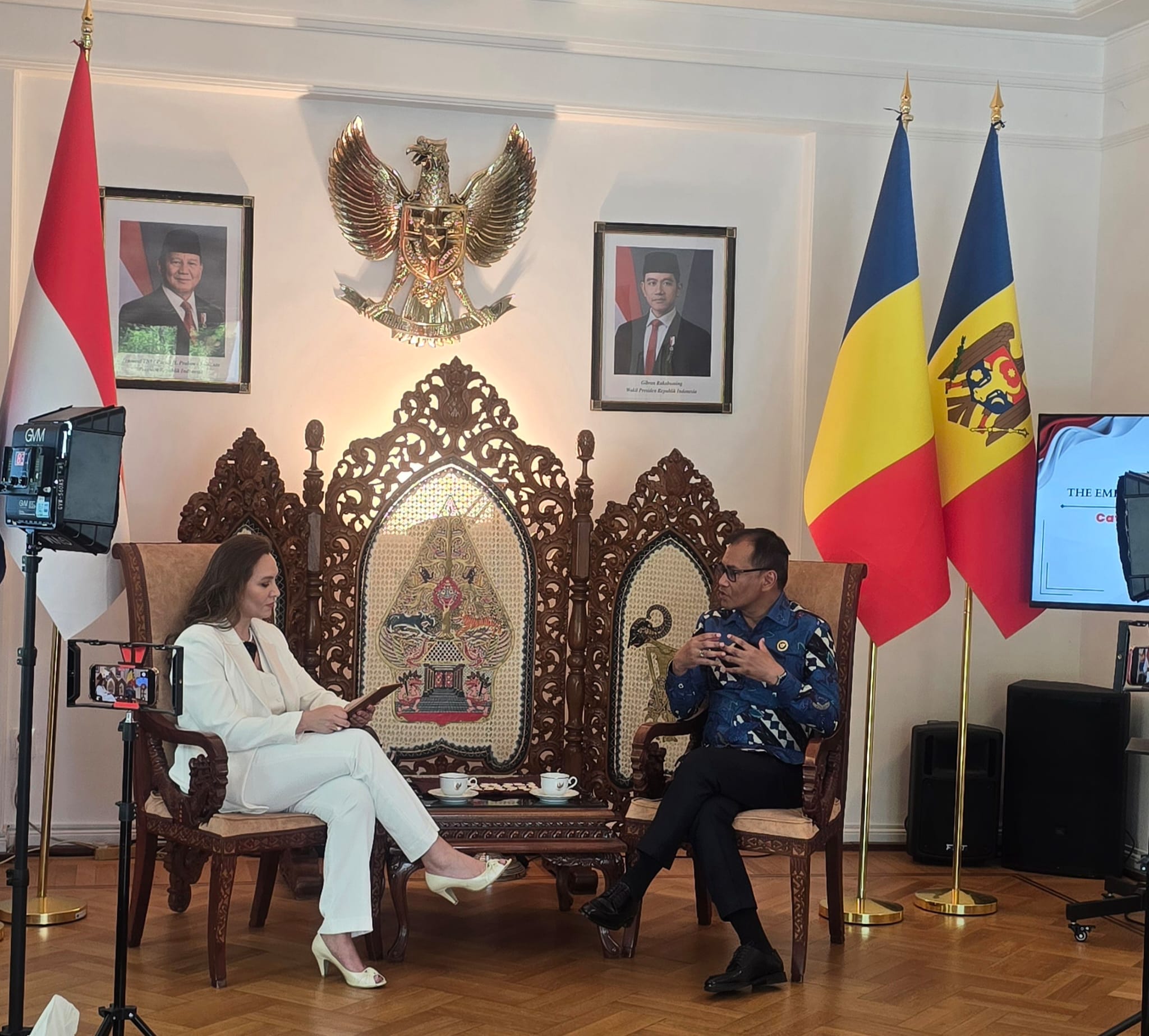
From “unity in diversity” to untapped trade potential, Indonesia offers Romania a compelling opportunity to deepen both diplomatic and economic ties. In a new episode of the Cultural Diplomacy Podcast, H.E. Mr. Meidyatama Suryodiningrat, Ambassador of the Republic of Indonesia to Romania, explores the values, leadership principles and business opportunities shaping the relationship between the two countries.
Indonesia is a country defined by scale and diversity. Spread across approximately 17,000 islands and home to hundreds of ethnic groups and languages, it has built its national identity around a powerful principle: unity in diversity.
Rather than asking people to abandon their cultural identities, Indonesia has developed a model based on coexistence, tolerance, compromise and community. These principles influence not only its domestic culture, but also the way the country approaches diplomacy and international relations.
H.E. describes Indonesia’s approach as one focused less on differences and more on shared interests: finding common ground first and building cooperation from there.
This philosophy has particular relevance at a time when geopolitical, cultural and ideological divisions are increasingly shaping international relations.
Diplomacy Starts with People
Before becoming a diplomat, the Ambassador Meidyatama Suryodiningrat built a career in journalism and media. Yet, in his view, the two professions have something fundamental in common: both begin with people.
Journalists engage with people to understand and communicate stories. Diplomats engage with people to negotiate, build relationships and create trust.
Technology may facilitate communication, but it cannot fully replace human interaction. His advice to younger generations is therefore simple: experience the world beyond the screen, meet people face-to-face, make mistakes, learn, and build genuine relationships.
Leadership, he argues, also requires discipline, patience and teamwork.
Technical expertise alone does not make a strong leader. At senior levels, one of the most important capabilities becomes the ability to manage people, build teams and create an environment in which different personalities can work together effectively.
The Ambassador as CEO
One of the most striking parallels in the conversation is between diplomacy and corporate leadership.
H.E. describes his role as similar to that of a CEO: responsible for finances, external representation, organizational management and the development of future leaders.
At that level, representation also becomes continuous. A CEO represents the company beyond formal working hours, just as an ambassador continually represents the country.
But leadership is not only about managing today’s organization. It is also about preparing the next generation. Assigning challenging responsibilities, mentoring younger colleagues and exposing them to new situations are all part of building future leadership capability.
Romania–Indonesia: 75 Years of Relations, but Significant Untapped Potential
The most commercially relevant part of the conversation concerns the economic relationship between Romania and Indonesia.
After 75 years of diplomatic relations, the political relationship is strong. Economically, however, the Ambassador describes it as a relationship with “unfulfilled potential.”
The two economies are in many ways complementary: Romania produces products Indonesia needs, while Indonesia has resources, capabilities and markets that could be valuable for Romanian companies.
Yet geographical distance has often become an excuse for limited commercial engagement.
The opportunity is considerable.
Agriculture and food
Romania’s agricultural sector could become significantly more present in Southeast Asia.
Indonesia imports approximately 11–12 million tonnes of wheat annually, while Romanian exports to the market have historically been limited.
Similar opportunities exist in livestock and frozen meat. Indonesia imported more than half a million livestock and approximately 180,000 tonnes of frozen meat in 2025, with Romania representing only a marginal share.
For Romanian producers looking beyond traditional European markets, Indonesia could therefore represent a significant diversification opportunity.
Digital, Technology and Renewable Energy
Agriculture is only one part of the potential relationship.
Indonesia’s population of around 285 million people and its highly connected consumer base create a large market for digital technologies and IT solutions.
Romanian technology companies, particularly those capable of scaling internationally, could find opportunities across Indonesia’s rapidly developing digital economy.
Renewable energy represents another area of convergence.
Solar, wind, water and waste-to-energy technologies are increasingly important for Indonesia, while Romania already has technology companies and innovators developing solutions in these areas.
The challenge for Romanian businesses is often not innovation itself, but international scale.
Entering a market the size of Indonesia requires time, local partnerships and long-term commercial commitment.
Nusantara: Building a Digital and Green Capital
Indonesia’s new capital, Nusantara, provides another illustration of the country’s ambitions.
The project is intended to reduce pressure on Jakarta, whose wider metropolitan area includes more than 30 million people, while creating a new administrative and economic growth center.
The ambition is not simply to reproduce Jakarta elsewhere.
Nusantara is designed around two core principles: digitalization and sustainability.
Green technologies, digital infrastructure, renewable energy, construction and smart-city solutions could therefore become relevant sectors for international investors and technology providers.
For Romanian companies operating in these areas, the project could represent an opportunity to participate in one of Southeast Asia’s most ambitious urban development initiatives.
Embassies Can Open Doors — Companies Must Walk Through Them
H.E. also offers a pragmatic perspective on the role of diplomacy in business.
Embassies do not conduct business on behalf of companies.
Their role is to facilitate the initial market-entry phase: connecting relevant partners, helping companies navigate regulations and permits, providing market intelligence and supporting the broader regulatory framework needed for bilateral trade.
Once relationships are established, however, the private sector must take responsibility for converting those introductions into commercial partnerships.
That distinction is important for companies considering expansion into unfamiliar markets.
Diplomatic institutions can reduce uncertainty and accelerate access. They cannot replace commercial strategy, market commitment or relationship-building.
From Distance to Opportunity
Romania and Indonesia may be separated by almost 10,000 kilometres, but geography does not need to determine the depth of their relationship.
The foundations already exist: strong diplomatic relations, complementary economies, mutual respect and growing interest in sectors such as agriculture, technology, renewable energy, infrastructure and trade.
The next step is awareness.
As the Ambassador suggests, the objective should be for the two countries to remain geographically distant but become increasingly close in terms of knowledge, cooperation and economic engagement.
Romania also has the potential to position itself as a gateway for Indonesian companies looking toward Central and Eastern Europe and the Balkans, particularly as its logistics and infrastructure capabilities continue to develop.
The opportunity therefore goes well beyond diplomacy.
It is about turning cultural understanding into trust, trust into partnerships, and partnerships into business.
Get real time update about this post category directly on your device, subscribe now.
